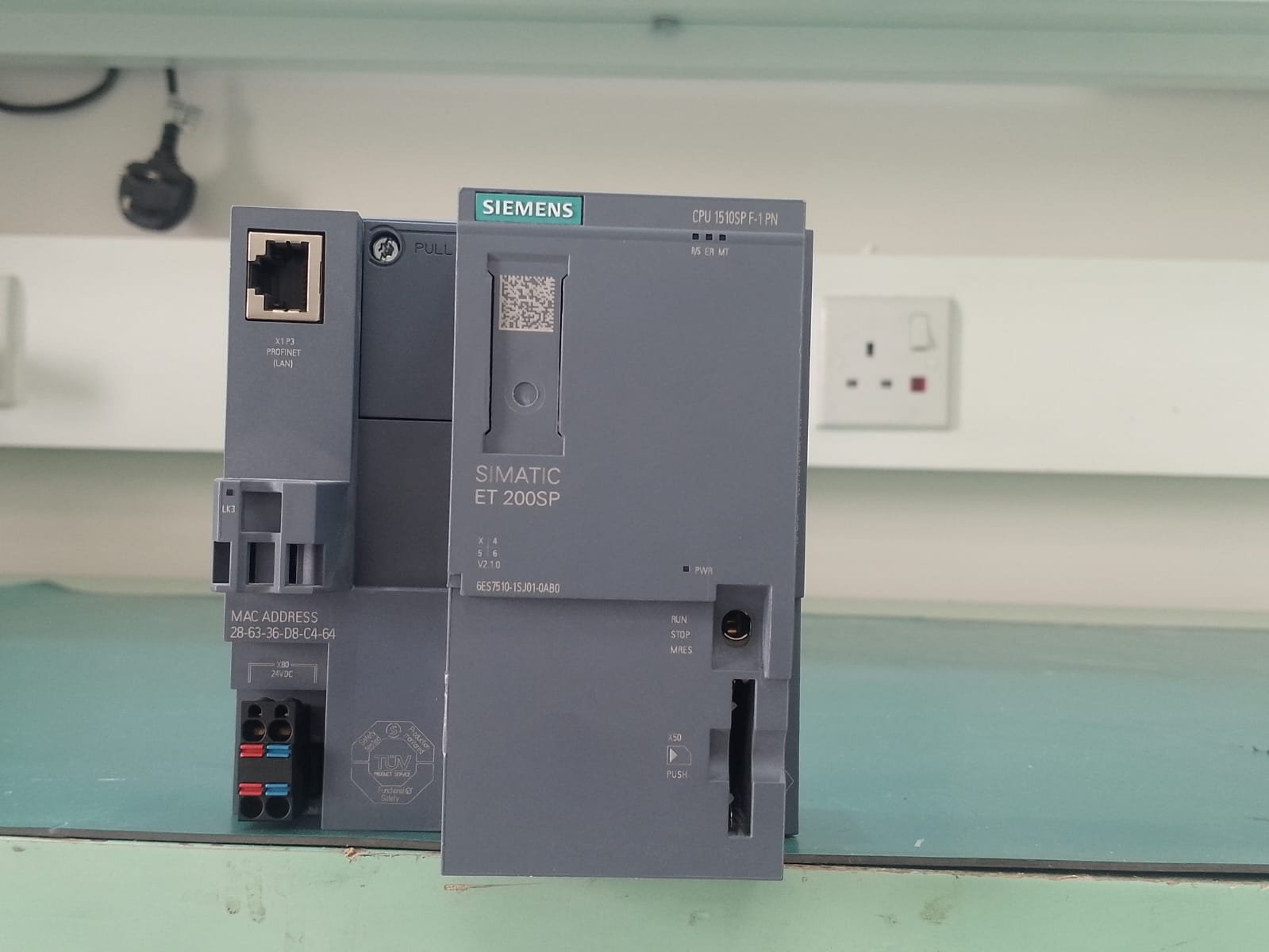
PLC Guide from Lab to Plant: Electronic-Level Repair, Programming and Projects
The PLC is the brain of the production line, and when it fails, everything stops. Some problems come from the program or settings, some are electronic faults inside the unit, and sometimes the best answer is to upgrade the whole system. In this guide, based on our Riyadh lab experience, we explain how to tell these cases apart and when to repair, when to reprogram, and when to plan an upgrade project.
Is it an electronic fault or a programming issue?
First, identify the type of problem:
- Hardware fault: the unit won't power up, the POWER LED is off, the ERROR/SF LED stays on after a restart, an output gives no voltage, an input doesn't read a present signal, or there are signs of heat or burning.
- Software or settings issue: the unit runs but the machine behaves incorrectly, the sequence is wrong, a timer or counter misbehaves, or the problem started after a program change.
- External fault: a failed sensor, a broken cable, a weak external 24V supply, or poor grounding causing noise.
A simple rule: if the status LEDs on the unit itself are abnormal, or the problem follows the unit when you move it, the fault is most likely internal.
The most common PLC electronic-level faults
These are the faults we see most often in our lab, and in most cases they can be repaired at component level without buying a new unit:
- Internal power supply: swollen or dried-out capacitors from heat, or a failed switching circuit, so the unit won't start or keeps restarting.
- Transistor outputs: usually burned by overload, or by relay coils and solenoids without a protection diode.
- Relay outputs: contacts wear out or weld after many switching cycles, especially with inductive loads.
- Digital inputs: damaged optocouplers or input resistors from overvoltage or wrong wiring.
- Analog I/O cards: unstable or wrong readings caused by a failed converter or voltage reference.
- Communication ports: RS-485 or Ethernet chips damaged by lightning or ground potential differences, cutting communication with the HMI, SCADA or drives.
- Battery and memory: on some models, a weak battery means losing the program or data during a power outage.
⚠️ Note: Before removing any PLC, back up the program if the unit still runs, and photograph the wiring and terminal numbers.
Programming: backup, reload and modification
Electronic repair is half the job; the other half is getting the machine back running with the same program. That's why we focus on:
- Backup: reading the program from the unit (where possible) and saving it before any repair.
- Reload after repair or replacement: downloading the program and verifying settings and network addresses.
- Program modification: adding sequence steps, safety interlocks, alarms, or new devices.
- Troubleshooting intermittent faults: online monitoring to find exactly which condition stops the machine.
We always recommend that every plant keeps an up-to-date, documented program backup for each machine; it greatly reduces downtime when a fault occurs.
When is a project better than a repair?
Repair is the fastest and most cost-effective option in most cases, but upgrading is the smarter decision when:
- The model is discontinued and spare parts are scarce (such as some older S7-300 and SLC 500 generations).
- Faults keep recurring across several cards.
- The plant needs remote monitoring, production reports, or SCADA integration.
- The machine needs a major change in how it operates.
Examples of PLC projects we deliver:
- Migration from legacy systems to modern platforms such as Siemens S7-1200/S7-1500, including program conversion.
- New control panels for machines and production lines with PLC and HMI.
- SCADA systems to monitor plants and lines and log alarms and data.
- Industrial networking between PLCs, drives and HMIs over Profinet, Modbus and EtherNet/IP.
Brands we work with
Siemens, Allen-Bradley / Rockwell, Schneider Electric, Mitsubishi Electric, Omron, Delta, ABB, LS Electric, Fatek, Keyence and more.
PLC services at the Rawad Alatmata lab
At our lab in Riyadh (Al-Dar Al-Baida – Al-Yaqout Road) we bring all three together: electronic repair, programming and projects.
- Free diagnosis and free quotation before we start
- Urgent repair within 1–2 working days for most faults
- Unit tested on a test bench before delivery
- Warranty of up to 8 months on repairs
- We receive units from all regions of Saudi Arabia
Learn more: PLC Repair in Riyadh · PLC & SCADA Programming and Integration · HMI Repair · Industrial PCB Repair
FAQ
Does every PLC fault require replacing the unit?
No. Most faults, such as power supply, outputs, inputs and communication ports, can be repaired at component level for less than the cost of replacement.
Will the program be lost during repair?
We make sure to back up the program before repair where the unit allows it, and reload it afterwards.
Do you program PLCs from scratch?
Yes. We program new systems, modify existing programs, and convert programs when migrating legacy systems.
My model is discontinued. What are my options?
We start with repair where possible. If faults keep recurring or parts are scarce, we propose a migration plan to a modern system with minimal downtime.
How long does a repair take?
Most faults are repaired within 1–2 working days, depending on the fault and parts availability.
Contact us: Send a photo of the unit and its model number on WhatsApp at +966 55 527 8768 for a free diagnosis and quotation.
WhatsApp: +966 55 527 8768Repair Services
Component-level industrial electronics repair at our specialized lab in Riyadh — free diagnosis, urgent turnaround and up to 8-month warranty.